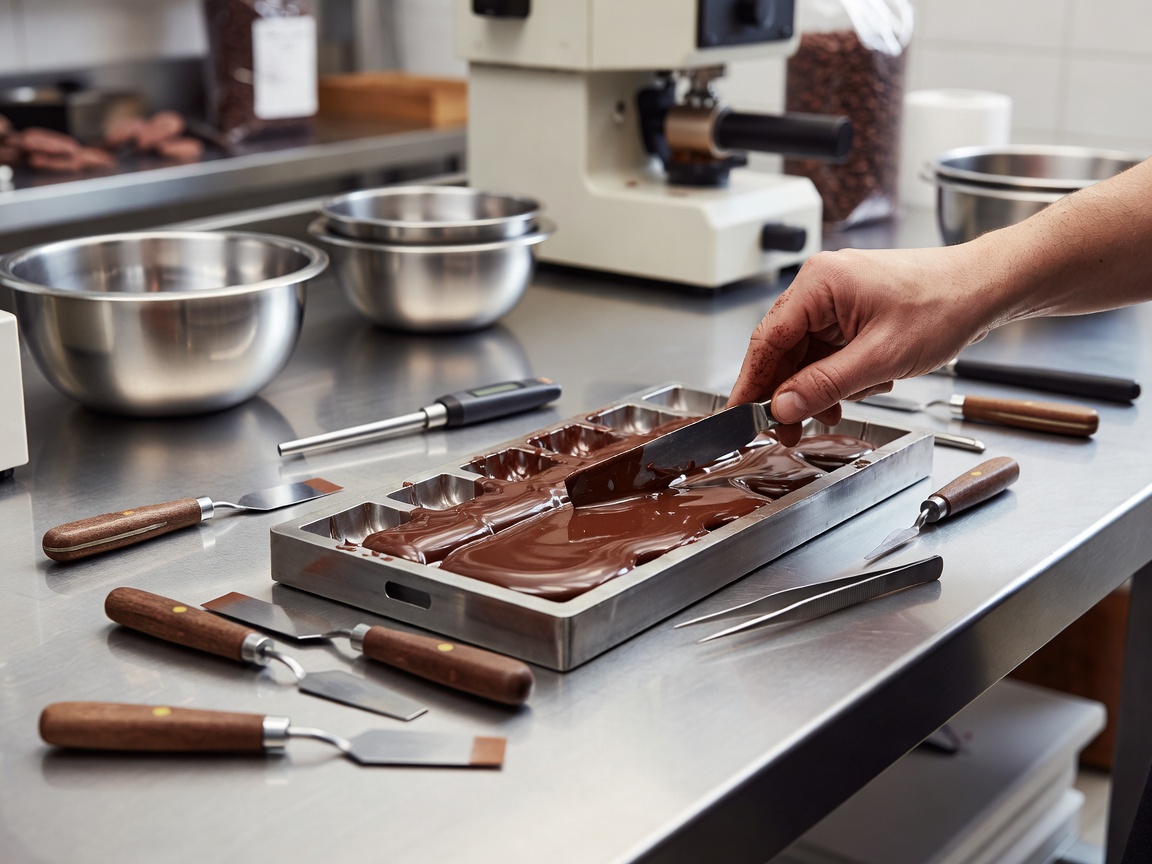
Tempering: preparing chocolate to set
Tempering is a controlled approach to working chocolate so that it can set with a firm structure and a smooth, glossy appearance. It involves managing how cocoa butter crystals form. A workshop may demonstrate the process with a work surface, bowl or temperature-controlled equipment. A beginner session might let participants observe or practice a limited stage rather than manage a full production cycle.
Results depend on the chocolate, method, equipment and room conditions. Follow the instructor’s method and product guidance. This overview is educational, not a substitute for formal training or a complete production procedure.
Molding and shell formation
Molding gives chocolate its shape. A mold is filled or coated, then excess chocolate may be removed to create a shell. In filled chocolates, the shell provides a structured outer layer for a center. A class may discuss mold preparation, coverage and the visual checks used to judge an even result.
Shell formation requires attention to thickness and coverage, but there is no single workshop sequence. Some instructors prepare shells in advance to keep a short class moving. Ask whether participants will make a shell themselves or work with a prepared one.
Filling and ganache
Filling means adding a center to a shell or shaping a center for a coated confection. Ganache is a mixture commonly made from chocolate and a liquid ingredient, often cream. Its texture and use vary with the formulation. A demonstration may explain mixing, consistency and how the center is portioned; a hands-on session may focus on piping or assembly.
Ingredients affect suitability for dietary needs and storage. Do not assume that a filling is dairy-free, nut-free or safe for a particular allergy. Ask the organizer about ingredients and cross-contact arrangements before attending.
Dipping, coating and finishing
Dipping coats a center or other piece in chocolate. The task involves handling, draining excess coating and achieving a clean finish. A workshop may use forks or other tools, with technique adjusted to the shape and consistency of the center.
Finishing includes decoration, surface detail and presentation. Participants might add a contrasting drizzle, textured mark or simple garnish. Decoration should support the product rather than conceal inconsistent shaping. The available finish depends on the time and materials in the session.
Setting, release and review
After shaping or coating, chocolate needs time and suitable conditions to set. A class may use prepared pieces so participants can compare stages without waiting through the full process. Molded pieces are released and inspected for appearance. The instructor can explain common issues, such as uneven coverage or a dull finish, in the context of that method.
Professional workshops may use equipment, quality checks and procedures beyond a beginner session. Do not infer professional competence from a brief demonstration. Ask what participants can practice, which steps are instructor-led and whether the class includes production context.
How workshops differ
A tempering class prioritizes chocolate behavior and handling. A praline class connects tempering with shell formation and filling. A truffle class may emphasize ganache, shaping and coating. A tasting-led session may explain techniques through finished examples without practical production. Duration, group size, equipment access and instructor demonstrations determine how much repetition is possible.
Good for: Beginners who want a guided overview; returning learners who want a focused method; groups comparing practical formats.
What to know: Confirm which steps are hands-on, what equipment is supplied, whether work is shared and what participants take away. Follow workshop safety instructions and the provider’s food-handling guidance. This guide does not provide professional food-safety procedures.
Related guides
Put the method in context
Compare the class before you book.
Look at the planned activity, time available and level of participant practice.
Compare workshop formats